Summary from the Stanford's Machine learning class by Andrew Ng
- Part 1
- Supervised vs. Unsupervised learning, Linear Regression, Logistic Regression, Gradient Descent
- Part 2
- Regularization, Neural Networks
- Part 3
- Debugging and Diagnostic, Machine Learning System Design
- Part 4
- Support Vector Machine, Kernels
- Part 5
- K-means algorithm, Principal Component Analysis (PCA) algorithm
- Part 6
- Anomaly detection, Multivariate Gaussian distribution
- Part 7
- Recommender Systems, Collaborative filtering algorithm, Mean normalization
- Part 8
- Stochastic gradient descent, Mini batch gradient descent, Map-reduce and data parallelism
Support Vector Machines
- Hypothesis and Decision Boundary
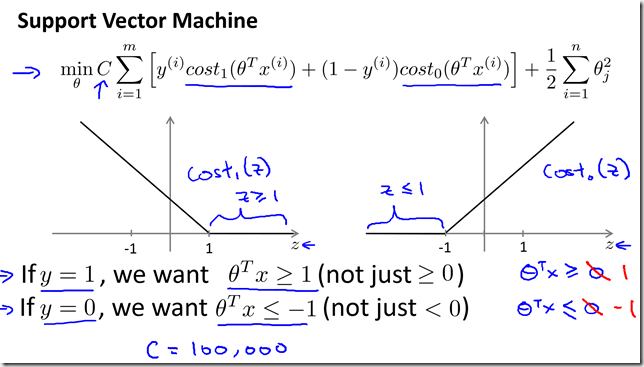

- Kernels
- For Non Linear Decision Boundary we can use higher order polynomials but is there a different/better choice of the features ?
- High order polynomials can be computationally heavy for image processing type problem.
- Given X, compute new feature depending on proximity to landmarks.


- When x = 3/5 the bump increases as its near to the landmark l(1), which is equal to [3,5], sigma square value makes the bump narrow or wide.

- Predict “1” when theta0 + theta1 f1 + theta2 f2 + theta3 f3 >= 0
- Let’s assume theta0 = -0.5, theta1 = 1, theta2 = 1, theta3 = 0
- For x(1),
- f1 == 1 ( as its close to l(1))
- f2 == 0 ( as its close to l(2))
- f3 == 0 ( as its close to l(3))
- Hypothesis :
- = theta0 + theta1 * 1 + theta2 * 0 + theta3 * 0
- = -0.5 + 1
- = 0.5 (which is > 0, so we predict 1 )

- How do we choose Landmarks ??
- What other similarity functions we can use other than ‘Gaussian Kernel” ??

- Kernels do not go well with logistic regression due to computational complexity
- SVM with Kernels are optimized for computation and runs much faster


Using SVM
Use software packages (liblinear, libsvm, …) to solve for parameters theta.
Need to Specify:
- Choice of parameter C
- Choice of Kernel (similarity function)
- No Kernel (“linear kernel”)
- Predict “y=1” if theta transpose x > 0
- No landmarks or features f(i) from x.
- Choose this when n is large and m is small. (Number of features is large and training examples are less)
- Gaussian Kernel
- Predict “y=1” if theta transpose f > 0
- Use landmarks
- Need to choose sigma square
- Choose this when n is small and m is large. ( very large training set but small number of features)
- Do perform feature scaling before using the Gaussian kernel
- Other choices
- All similarity function need to satisfy a technical condition called “Mercers Theorem”
- Polynomial kernel
- More esoteric:
- string kernel
- chi-square kernel
- historgram intersection kernel
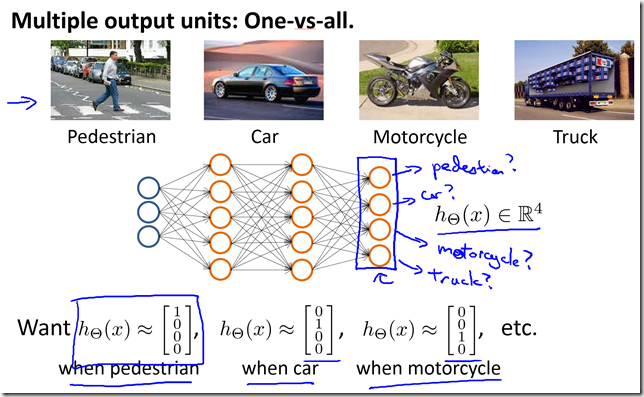
Many SVM packages already have built-in multi class classification functionality, if not use the one-vs-all method
- Logistic Regression vs. SVM